UK padel has doubled, but there's subtlety beneath it.
In the twelve months to August 2025 the UK approved 312 padel planning applications with 629 lodged. In the twelve months since, it has approved 649 with 1,150 lodged. Here is what you need to know.
The pipeline has doubled
Courts, approvals and applications doubled in the same number of days, at the same average size. The twelve months to August 2026 include a provisional August, so all three volume figures are floors.
Submissions and approvals, monthly
UK padel planning applications by month of validation (submitted) and month of decision (approved), including amendments to consented schemes. August is provisional and will be locked in by the end of September. Expect it to grow as councils report late.
Growth is still accelerating rather than levelling off. December alone carried 131 applications, the biggest month on record, and every one of the last four quarters has beaten the same quarter a year earlier.
The quieter movement in that chart is the two bars converging. In March there were 70 approvals against 115 submissions. By July it was 72 against 93. The winter surge is finally reaching determination, which means a good part of this year's approvals is a queue clearing rather than fresh demand.
What is actually happening
The volume is the easy part of this story. Five things underneath it change what you would actually build, and where. Jump straight to any of them.
- Scheme size. Every size of scheme grew. The small end just grew four times faster.
- The format. Big padel has become a conversion business, not a construction one.
- Cover. A roof is the price of scale.
- Recent months. August cleared faster than any month bar February, and refused more.
- Demand. Supply is now growing faster than play.
The market is tilting small
Approved schemes by court count
Share of approved new-court schemes where the court count is stated in the application. n = 173 (to Aug 2025) and 352 (to Aug 2026). Roughly a third of applications never name a number and are excluded.
Read that chart as a shift in emphasis rather than a decline. Three and four court schemes went from 71 approvals to 97, up 37%. They fall from 41% to 28% of the mix only because the small end grew close to four times faster, from 88 approvals to 201.
The small end is bolt-ons: two courts added to a tennis club, a cricket club, a school, a pub car park. The large end is conversions in big sheds, where the maths often favours economies of scale. The mid-size standalone build, four courts on a piece of land, is still going up in greater numbers than a year ago. It is simply no longer where the growth is.
A roof is the price of scale. Covered and indoor schemes average 3.18 courts against 2.51 outdoor, and the covered share of approvals rose from 31% to 38%. Above four courts, an uncovered UK scheme is close to a rounding error.
Why is less certain from the planning data alone. It may be the cost of canopies and groundworks, which only starts to make sense spread across more courts. Or it may be that operators are moving towards an all-in-one venue, with a gym, pilates and other amenities alongside the courts, and that model needs a big box unit to begin with.
Padel is absorbing empty buildings
Change of use went from 22% of new-court submissions in the year to August 2025 to 29% in the year since, and conversions out of industrial, warehouse and retail stock went from 50 applications to 151.
August's approvals read like a survey of what British high streets and trading estates have stopped needing: a former Homebase on Finchley Road, a furniture showroom in Carlisle, the old Floors To Go building in Bury, and the list goes on.
Conversions are not significantly larger on average. But at the top of the market they are close to the only thing happening.
| Courts | Decided | Scheme | What it was |
|---|---|---|---|
| 12 | Dec 2025 | Merlin Way, North ShieldsNorth Tyneside | B2 industrial unit |
| 10 | Sep 2025 | Trident Trade Park, CardiffCardiff | Two trade park units |
| 10 | Mar 2026 | Belfield Hall Farm, Albert Royds StreetRochdale | Farm building, three-year consent |
| 10 | Aug 2026 | Former Homebase, 255 Finchley RoadCamden | DIY superstore |
See the biggest planning applications in the country
See all 47 approvals of five courts or more from the last twelve months, with addresses, decision dates, court counts and what the building used to be.
No sign-up required to look around.
July was bigger than we told you
Last month's issue reported 63 applications lodged in July. Now that the portals have caught up, the confirmed figure is 93. Approvals moved from 69 to 72, withdrawals from 11 to 13, refusals from 5 to 7.
Reported on the first of August, July looked like a sharp fall from June. It was not. July was an ordinary month that had been given one day to be published. We watched it fill in: 63 on 1 August, 79 by the 20th, 93 today, and it is still not finished.
Because of this we now only confirm a month's figures in the month that follows it. Here is August so far, provisional, with our projections.
On average, councils publish to their planning portals about 16 days late, and some are much later, so a month keeps filling in after it has ended.
July's numbers are locked. August's are provisional and will rise.
What August put through
July, confirmed: 72
July, confirmed: 100
July, confirmed: 93
Twelve-month average: 86%
Twelve-month median: 85
Councils cleared August's padel casework faster than any month in the two years we have tracked bar February, and refused a fifth of it while doing so. Expect that reading to slip: the back half of the month is only part counted, and the slower cases are the ones still to arrive.
Do not over-read the refusals. The monthly rate has swung between 7% and 20% since March, and across the last six months it sits at 14% against 13% for the twelve months before. Nothing structural has changed.
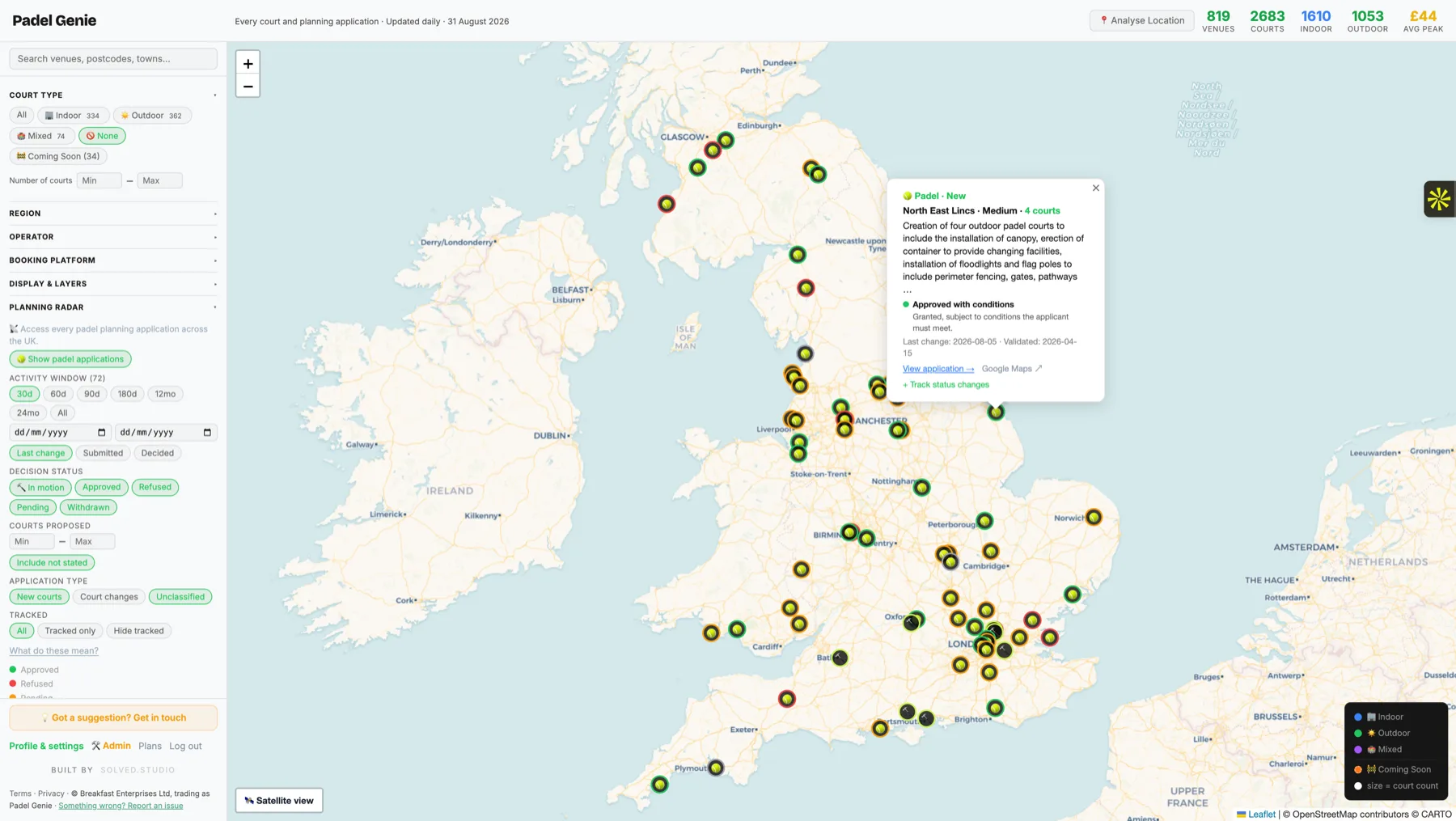
The month's biggest decisions
| Courts | Decided | Scheme | Region | Note |
|---|---|---|---|---|
| 10 | 12 Aug | London | All-weather canopy. Temporary consent. | |
| 9 | 18 Aug | Hertfordshire | Retrospective. Built, then consented. | |
| 6 | 7 Aug | Midlands | 22,000 sq ft shed to indoor club | |
39 more August approvals, and the 48 applications lodged
See every UK padel scheme decided or submitted in August, with the site address, the court count, the decision date and a link to the council's file. Updated daily as the portals publish. Set alerts to stay ahead of the market for new applications landing in your chosen area.
August's average approved scheme was 3.28 courts, the highest monthly reading in the series, until you take out Camden and Hertfordshire. Without those two it is 2.50, below the twelve-month average. August did not produce bigger schemes. It produced two big ones.
Camden is the one to watch. Ten courts under an all-weather canopy in a dead Homebase on Finchley Road, on a temporary consent, is the clearest statement yet of the economics: a covered product that trades all winter, and a lease short enough that the landlord keeps the redevelopment option. Expect it copied.
Hertfordshire is the one to think about. Nine courts at a sports ground there were consented retrospectively. They were already built. Retrospective applications have run at 3 to 6% of submissions all year, which says something quiet about how far ahead of planning some operators are willing to run.
On the other side, ten refusals, and not marginal ones: one scheme of five courts and two more of four. Three of the ten were warehouse or industrial conversions, so the shed route is not sailing through unopposed.
Consents are the easy half
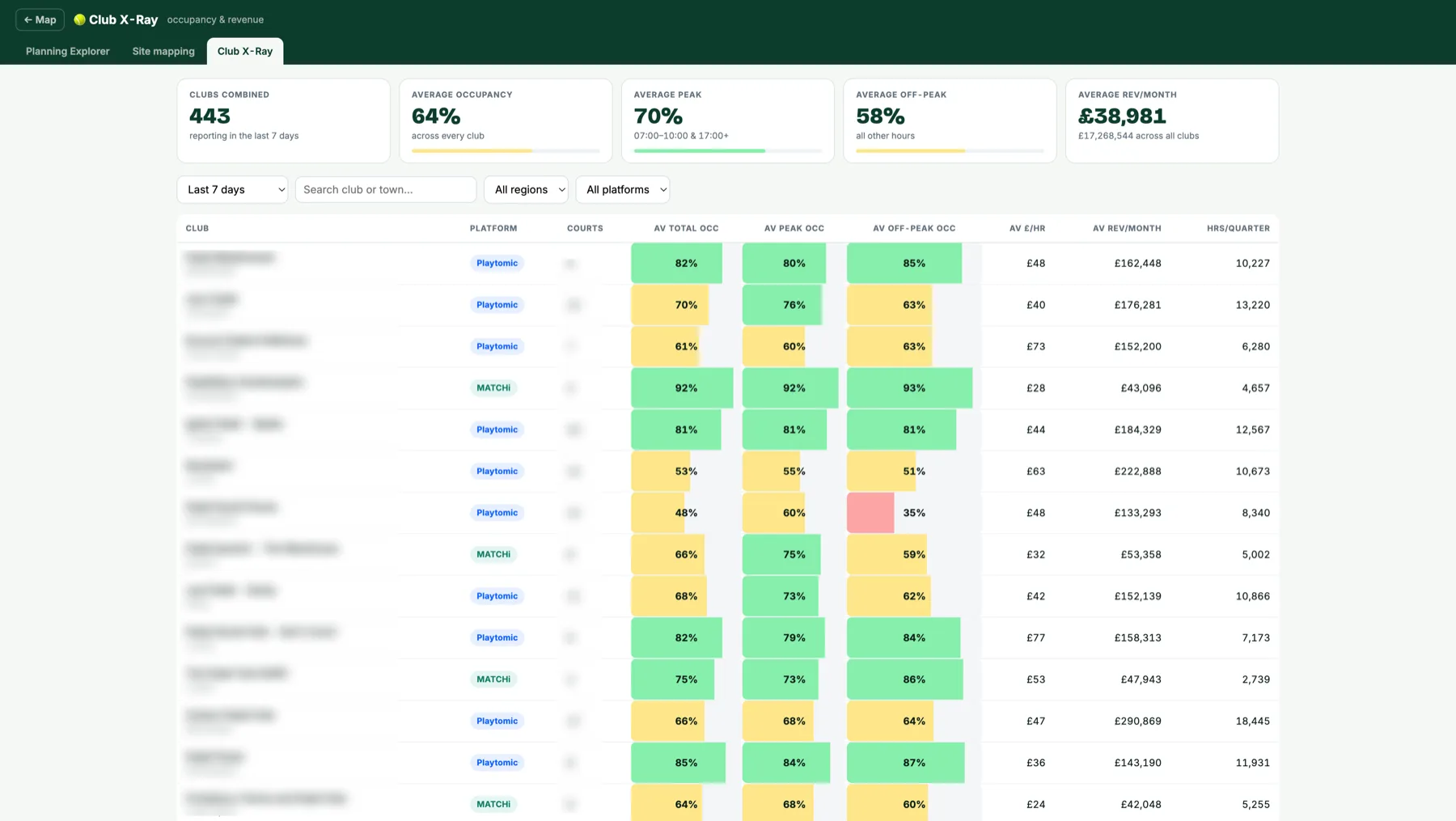
The harder question is whether the courts already open are busy. Across the clubs we track, average occupancy was down in August against July.
Some of that is the calendar. August is the emptiest stretch of the padel year here, and this one was hot enough that plenty of people who would normally book did not fancy a game in over 30°. But the denominator moved too: the open fleet keeps adding courts faster than bookings are growing to fill them, and average court pricing has not moved to defend it. It is too early to know whether supply is outpacing demand, but it certainly does not feel like it. We will see what September does.
Besides, occupancy alone can be a poor scoreboard. The two highest revenue-generating padel clubs in the country in August were Carbon Padel Club and Rocks Lane Chiswick, and they finished within a whisker of each other despite being different businesses: Carbon on seventeen courts, Rocks Lane on twelve. Neither ran the highest occupancy rate in the country. Court count, price and the shape of the booking day decide the revenue, and counterintuitively, a club optimising for a full grid can often be leaving money on the table.
Three things to watch in September
Whether the convergence holds. If September's approvals come in above its submissions, the winter backlog is genuinely cleared and the market is running at its natural rate rather than working through a queue.
Sheds. Conversions have tripled in a year and now carry the top end. Three of August's ten refusals were conversions. One month is noise, but if that ratio holds through autumn it constrains the only route currently producing eight-court venues.
Whether the new courts fill. The consented pipeline is roughly half the size of the open market, and much of it is covered courts in northern industrial cities that have never had a padel club. Planning tells you what is coming. Occupancy tells you whether it should. Next issue we will report occupancy and revenue across the whole of August and show how the numbers actually moved.
Track it as it happens
Padel Genie maps every UK padel venue and every padel planning application, updated daily as councils publish. Operators and suppliers use it to see what is being built, where, by whom, and how far along it is.
What do you want to know about next?
Let me know, and I will look to include it in the next issue for you.
Anonymous. No email, no name, nothing attached to you.
Enjoy this blog?
Glad it helped. Want next month's the morning it publishes?
What would make the next one better? We are always trying to improve.